Edmund
The Last BattleEdmund Pevensie returns to Narnia as King Edmund, one of the crowned rulers who arrives at the world’s end and joins its final passage into Aslan’s country. His role bridges the practical history of the Magic Rings and the train journey with the last revelation: the railway accident has taken his life in the Shadow-Lands, but death opens onto a greater story rather than closing his own.
Identity and Return
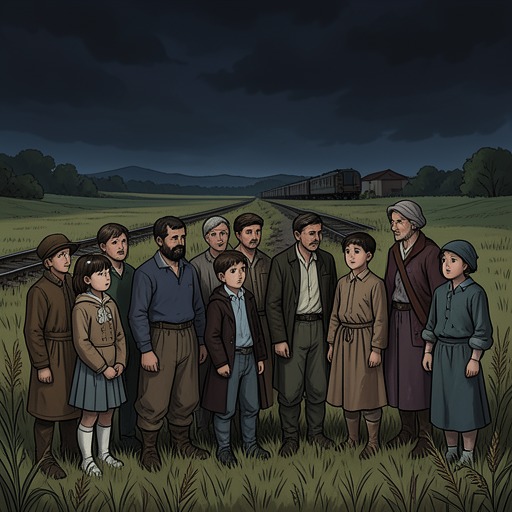
Edmund is among the older Pevensies who cannot return to Narnia by the route available to Jill Pole and Eustace Scrubb. When Tirian later asks how the others came, Edmund and Peter explain that they had been waiting at a railway platform to meet the younger pair. Their account places Edmund in the final journey alongside his family and friends, not as a solitary adventurer but as one of the group drawn together by Narnia’s approaching crisis.
The attempt to reach Narnia had begun with the Magic Rings. Peter and Edmund went to London early in the morning, dressed as workmen so they could enter the back garden where the Rings had been buried. The house had been sold, making recovery a practical obstacle as well as a matter of faith in the old means of passage. Peter later sent a wire confirming that he had found them. Edmund’s part in this episode is concrete and preparatory: he helps recover the object believed to offer a way back, even though the final crossing does not happen as planned.
The Railway Journey and Its Reversal
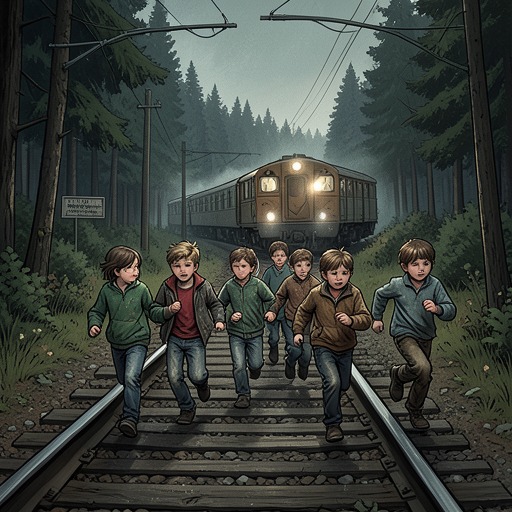
On the day Jill and Eustace were to return to school, Peter and Edmund were meant to meet them on the way and hand over the Rings. The younger two boarded a train with the Professor, Polly, and Lucy, intending to stay together as long as possible. As the train approached the station where Peter and Edmund were waiting, a violent jolt and noise transformed the journey: the children found themselves in Narnia, with Tirian tied to a tree. The Rings had not been used. The expected passage through a recovered magical object was overtaken by an event none of them had chosen or controlled.
At the end of the world, Edmund gives the group’s account of the accident and its bodily strangeness. He says it was unlike the earlier occasions when magic had pulled them from their world: there was a roar and a blow, but no pain. He had been excited rather than frightened, and noticed that a rugby injury—a sore knee—had suddenly disappeared. He also felt unusually light. These details make the transition legible through a change in physical experience: an injury vanishes, the body feels released from weight, and the group arrives in Narnia.
Digory adds that he and Polly felt as if they had been unstiffened and had stopped feeling old. Jill answers that, in Narnia, the two do not seem much older than the younger visitors. Edmund’s account therefore belongs to a shared crossing, but it also helps distinguish the experience of the older pair: for them, arrival includes a renewal of bodily age and condition.
King Edmund at the End of Narnia
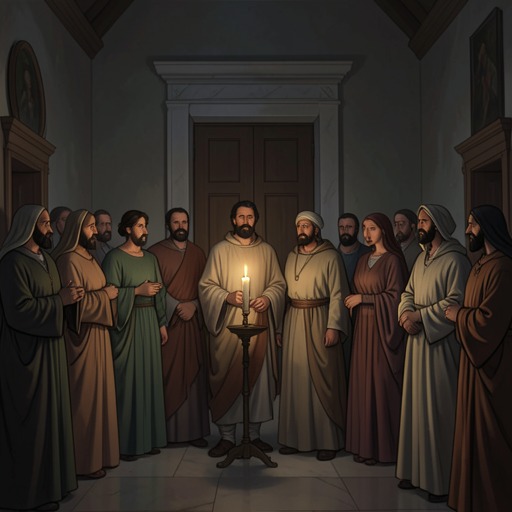
When Tirian first encounters the seven crowned kings and queens, Edmund stands among them in glittering clothes, with a sword in hand. Tirian recognizes him as the youngest king beside Jill, though both look changed from their earlier meeting. The arrival reverses the battle’s physical aftermath: Tirian feels awkward about appearing bloodied, dusty, and exhausted, only to realize that he too has become clean, cool, and dressed for a feast at Cair Paravel. Edmund is part of this renewed company of rulers at the threshold of a different order.
Tirian greets Peter first, then is introduced to Edmund as Peter’s brother and to Lucy as Peter’s sister. Edmund’s place in this formal introduction makes the old Narnian order visible even as its history is ending. Tirian asks about the other queen, Susan; Peter answers that she is no longer a friend of Narnia. Edmund is present for this disclosure, which sharply marks the limits of the reunited company: the Pevensies have not all returned together.
The final events unfold under Edmund’s witness. Aslan calls, “Now it is time!” and the Door opens. The stars are summoned home; their light drains from the sky as the spreading blackness is revealed to be emptiness, not cloud. The stars descend as people, and the gathered creatures rush toward Aslan. Edmund sees the decisive separation at the Door: those who look on Aslan with fear and hatred turn into the darkness, while those who look with love, even when afraid, enter on his right. Some former Talking Beasts lose speech and become ordinary animals in that moment. Among the welcomed are creatures the company had thought dead, including Roonwit, Jewel, Farsight, Poggin, the Dogs, and the Horses.
Death, Judgment, and the Great Story
After the world’s destruction, the company learns that the railway accident was real. Aslan tells them that their father, mother, and all of them are dead, using the language of the Shadow-Lands to describe the change: the term has ended, the holidays have begun, and the dream has become morning. Edmund’s earlier account of the painless blow and vanished knee acquires its final meaning in this revelation. The experience was not simply another magical transport from one world to another; it was the crossing that followed death.
The ending does not treat that disclosure as a cancellation of Edmund’s life or Narnian history. The narrator describes the children’s former lives and Narnian adventures as the cover and title page, while the real story begins beyond them. Edmund thus reaches the final threshold as both a returning king and a dead child entering a new reality. His presence carries the narrative from remembered Narnian history, through the end of the world and its judgment, into the promise of an unending story whose chapters grow better rather than cease.